Showing posts with label Historic Inspiration. Show all posts

Tuesday, 27 September 2016

Historic Inspiration 2: Sumer and Civilization

Hello everyone!

This week for historic inspiration I'll be looking into Sumer, the first urban civilisation - credited with a fair amount of important developments that persist to this day! With this in mind - I'll be looking into the elements of a civilisation - things to that can help when designing a civilisation within a fantasy context.


A Word on the Provided Information

Please note that research was done using mostly secondary and tertiary sources of information - so keep this in mind as you are reading through. What this means is that the information present is not directly from documents that speak of these events. Information used is from, not exclusively Museum visits, and online research. Whilst this information may hopefully be useful for the sake of inspiration for example - I do recommend further research to confirm the information if you are seeking solid information on the history of Malta for the sake of things such as, but not exclusively, academic work. Think of this as more of an exploration and research of an individual.
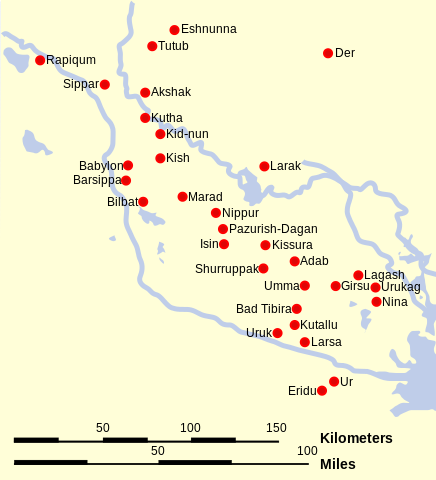
Map of Sumer

Raising Cities

When we say that Sumer is credited to being the first urban civilisation - it is because they were the first to construct large cities - some of which housed tens of thousands of people. Given the time period of around 3500 B.C. - this is an incredible achievement. To help put this figure into perspective - a Roman census at around 508 B.C. 130,000 assumed over 17 males were counted in the Roman populace - if we were to double that to assume the female population we would have 260,000 Romans. One of the larger Sumerian cities may have very well had around 80,000 citizens. 

Mesopotamia - the home region of the Sumerian - was dotted with a number of city-states that the Sumerians dwelled within. Each of these city states would be centered around the worship of a particular god or goddess - ruled over by a priest or king. The name of the region itself - mesopotamia - meaning the land between two rivers in Greek - would have offered the Sumerians a beautiful landscape with food and water being available close-by. The rivers, the Tigris and Euphrates themselves had a much deeper important to the civilization outside of food and water - it served as a major method of transportation. The waterways also became a critical component for trade routes - particularly due to the type of terrain that the civilization was located in.

Some of the city states of the Sumerians include Eridu, Bad-tibira, Larsa, Sippar, Shuruppak, Uruk, Kish, Ur, Nippur, Lagash and a number of others. After a number of hunter-gatherers began planting gardens, as well as growing crops that needed permanent settlements - this would have encouraged a more permanent residence for the societies. This needless to say - opened vast opportunities for the society to begin developing in ways that would have been difficult had they been nomadic. Building houses, planting crops, developing tools and ideas that would have been innovative at the time. 

With food taken care of - individuals could begin specialising in new occupations - pottery, smithing, trading, carpentry, weaving and so on. As the Sumerian economy grew - the need to calculate and record the supplies and goods of the economy grew. So came the development of one of the oldest - if not the oldest forms of writing. Sumerian writing was done on clay tablets - using streamlined pictures to represent ideas or goods. Developing further into phonetic letters later on to develop cuneiform - for symbols of spoken sounds.

As the city-states grew - the need for land grew, more over, boundaries that once separated city states became questioned; leading to war between Sumerian city states. War acted as a major driver towards pushing the boundaries of technology with the Sumerian city-states. Warriors of the time would have been armed with mostly copper and leather based equipment. Most likely copper helmets, a spear, sword and leather shields. Certain stela designs show what seem to be a phalanx formation used by warriors of certain Sumerian kings. This would pre-date the use of the phalanx within Greek society by a fair margin. 

Other equipment used and developed further by the Sumerians are chariots as well as the sickle sword that would become a standard infantry weapon used by the Egyptians at a later date. Certain socket-axe designs may have also been developed - as body armor designs improved within the region. Perhaps one of the most interesting aspect of this period is the fact that the warriors of Sumer may very well be the first standing professional army in human history.

Decline of Sumer

The decline of the Sumerians came primarily in the form of hunger, malnutrition and disease - as the land used for farming had increasing amounts of salt due to evaporating waters left behind salts in the soil after the water level had risen. The salt - having been spread due to the irrigation channels, meant that vast areas once useful to grow wheat - became far less fertile as the years went by. The salt itself - hardened by the sun, whiting the terrain and prevented further cultivation. Another large factor that lead to the spreading of illness included the fact that garbage was often burnt - if not simply left in the streets. Weakened Sumerians were ill-equipped to defend with invaders due to this. After being conquered by Sargon the Great - the Sumerians regained their independence only after the empire of Sargon fell. Only after this period of renaissance were the Sumerians again conquered by the Amorites (Westerners) did the Sumerians slowly began to vanish as an identifiable ethnicity - as the Amorites adopted the Sumerian culture. Another aspect that seemed to have lead to the decline of the civilization seemed to be due to rigidity. Whilst at the start - the Sumerians were innovators and built new ideas and concepts - they eventually seemingly became highly restricted in terms of their freedoms. As to why this was the case - is debatable. The Amorites slowly began to expand and Hammurabi was one king that began to expand his influence throughout Mesopotamia.

Like Sargon before him, Hammurabi built networks of roads and postal systems to help connect the vast cities under his rule. Delegating power to governors to rule his in stead. Babylon - became a city where trade routes crossed - becoming a centre for skilled artisans, architects, and businesses. The city was surrounded by vast fields of crops - such as melons and barley - and previous materials including timber and metals were imported - if they were not available locally. In 539 BCE - Cyrus the Great of Persia conquers Babylon. The ideas and concepts, the knowledge and techniques used by the Sumerians - rather than lost to history - continued through the Greeks and Persians. 

Sumerian Developments

Whilst one must keep in mind that many technologies, ideas and concepts might have developed independently through the world - be it in China, Mesopotamia, or South America for example. It is still worth noting the ingenuity of the Sumerians. For example, the Sumerians had issues of flooding - so they developed irrigation and dams that not only helped them relieve the issue of rising water levels - but also help in agriculture.

As trade flourished - the Sumerians were very fond of lapis lazuli - this lead to the creation of contracts. These first contracts were done by rolling cylinder with a relief onto a clay tablet. The relief on the clay tablet - became the contract. This eventually would lead to the creation of the first laws. The code of Hammurabi is a well preserved Babylonian code of law that helps us see what the laws of Sumerians may have involved.

Below are a few credited concepts or items to the Sumerians.
  • Creation of the Wheel
  • Cuneiform Writing
  • Mathematical Measurements and Systems (Time Measurements for example)
  • Sail Boats
  • Agricultural Processes [Irrigation]
  • Concept of Cities
  • First Legal code

Civilisation in Fantasy

Aside from the inspiration to be taken of the Sumerians and their civilisation - as I did my research I asked the question as to what exactly qualifies a civilisation to be a civilisation? Charles Reman - based on work by Gordon Childe - create 10 characteristics that may help look at civilisation. 

Primary Characteristics of a Civilization
  • - Urban Settlements
  • - Full Time Specialists not involved in Agricultural Activities
  • - Concentration of Surplus Production
  • - Class Structure
  • - State-Level Organization (Government)

Secondary Characteristics of a Civilization
  • - Monumental Public Building
  • - Extensive Trading Networks
  • - Standardized Monumental Artwork
  • - Writing
  • - Development of Exact Sciences

However - an important criticism or aspect to keep in mind - is that these are not always true. Aztecs did not have writing, the Mongols had little urban settlements, the civilisation that built stonehenge seemed to have no state-level organisation nor writing etc. These provide a framework - however one should not fall into the trap of thinking these are must have characteristics. Other elements we can keep in mind are;
  • Art and Architecture
  • Writing
  • Social Structure
  • Religion
  • Culture
However again - we must keep in mind that these are guidelines - and not necessarily a must have characteristic. These do however provide a means to imagine what exactly would it take to create a civilisation in a fantasy setting that feels alive in a way. That has depth and makes sense if that is the aim. 

I hope you found this to be interesting as much as I did, and useful if you are looking into the creation of a civilisation! There is much more to the Sumerians that one can learn that would have likely taken up multiple posts - so I do encourage you to delve deeper into areas you may find to be of particular interest!

Until next time,
Dylan

Tuesday, 23 August 2016

Historic Inspiration 1: Malta and the Fortress Economy


Hello everyone,

This week I bring you a post that is focused towards bringing inspiration from history to fantasy settings. One of the challenges and joys I find, of creating a new fantasy world is that of making a compelling and often authentic world. When I say authentic - I do not mean 'realistic' in the traditional sense - but rather believable - making sure it is consistent and makes sense in the eyes of those experiencing it should they live within that world. 

This post - as will others of this type, will provide elements of real-world history based on research I've made that can be used both as inspiration and ideas for fantasy worlds. It seemed natural to begin with Malta - my home country.

A Word on the Provided Information


Please note that research was done using mostly secondary and tertiary sources of information - so keep this in mind as you are reading through. What this means is that the information present is not directly from documents that speak of these events. Information used is from, not exclusively Museum visits, and online research. Whilst this information may hopefully be useful for the sake of inspiration for example - I do recommend further research to confirm the information if you are seeking solid information on the history of Malta for the sake of things such as, but not exclusively, academic work. Think of this as more of an exploration and research of an individual.

Malta and the Fortress Economy


Malta, an island to the south of Sicily, Italy, has been part of rich historic events. Dating from the fall of Carthage to Rome, to the defeat of Ottomans by the Knights of Saint John and their Maltese allies. The island has a rich history of medieval fortifications and is the center of a very key concept I would like to discuss today. The timeline provided will also be useful should you wish to follow through historical events or conduct your own research on specific points of history.


Malta History Timeline
Public Domain Background Photo courtesy of
www.photos-public-domain.com 

Fortress Economy

Malta itself - is an island deprived of much natural resources. During the periods of the first settlers of the island - the island was far richer in vegetation, which likely formed the basis as to why the settlers chose to settle on the islands. Food would have been abundant - and fishing would have provided when foraging would not. Tools however - would need to be made from wood, stone, or brought from other lands. Bronze, obsidian and other types of tools would have been brought from, most likely, Sicily. The material would be recycled and re-used as often as possible due to the scarcity of it's availability. One particular resource that was sought after highly during these periods were the corals that were used to create jewelry. These coral jewelry were seen as good charms - and high demand saw the diminishing of Malta's coral life. 

When Phoenician traders arrived on the island's shores - they were highly welcomes by the locals. Eventually choosing to creating a colony on the island - and which are believed to give the island it's name sake Malat, meaning something along the lines of sanctuary. Being the savvy sailors they were - the Phoenicians enjoyed having a strategic place to settle during storms for their trade ships. Eventually - the Phoenicians fell to the Persian empire; Carthage - a previously Phoenician colony took Malta under it's wing. 

The Carthaginians were quick to solidify the advantage they took from Malta's strategic location. Malta was turned into a Carthaginian naval base. This was perhaps the first point we begin seeing Malta's evolution as a fortress economy. Malta would serve as both a trade center for Carthage as well as a launching platform for the Carthaginian fleet. Whether the island served to construct ships, or simply maintain and house them - is up for debate. The island's lack of timber supply would likely mean that timber would need to be transported to the island - which wouldn't make much sense if the ships could be built elsewhere. Following the fall of Carthage - Malta went into the hands of the Romans. 

Malta was of little significance in terms of resources for the Romans - especially due to it's vast scale. Malta however - did offer the same benefits to the Romans in terms of being strategically located in the midst of trade routes and a good supply point for Roman ships. As the Romans attained undisputed control of the Mediterranean - trade would have likely flourished - together with the island itself. Eventually - Roman veterans were also given lands within Malta - as rewards for their service. These veterans would provide the island with perhaps it's first fortified settlement - Melita.

Malta would be conquered by the Vandals, Goths and eventually returned to the Romans (Byzantines) until the island is captured by Aghlabid Arabs. The Arabs would reduce the size of Melita - and form Medina - the city which would be the precursor to Mdina. The Arabs also introduced cotton and cirtus fruit, as well as new agricultural practices and irrigation systems. The Arabs also constructed a fort on the location of present day, Fort St. Angelo. Eventually - after being under Norman control, the Knights of Saint John would be granted Malta by Emperor Charles V.

The Knights would construct fortifications on the island, conduct corsairing activities and raid Ottoman trade routes before repelling an invasion by the Ottoman empire. The Knights would continue to construct fortifications for the decades to come. Until eventually the French - under Napoleon Bonaparte would come to Malta and bring forth extensive reforms - until being kicked out of Malta by the Maltese for the sacking of churches and cathedrals, eventually with the aid of the British. 

Malta would become a critical naval outpost for the British. Prospering during war-time but suffering during peace. Eventually - with the opening of the Suez Canal - Malta would again prosper for a time. This common theme throughout history as Malta's importance grew extensively when it's strategic location came into play. However, during times of peace, and with improvements of ships that allowed for lesser maintenance and longer range, Malta's key position for trade began to waver. 

Malta's size meant that mass manufacturing would not compete with that of foreign nations. For a time, cotton production was lucrative some time during the wars in America - as cotton production from Americas was halted. The ports and hospitals of Malta would see extensive use during world war 1; and during world war 2 - Malta would bear massive hits by bombing raids from the Axis powers. 

With all this - Malta's role in the modern day after gaining it's independence and becoming a republic - meant that the fortress economy needed to be changed. Especially since Malta's position in the global arena was a neutral country that would seek to bring peace. This means that Malta's old prosperity during war, and down slope during peace - needed to change. Malta would change it's economic situation by focusing on areas such as Tourism, Financial Services and IT. Which gave the island a way to utilize the least land but provide high returns. Malta's greatest resource would be it's citizens - meaning that an investment to the individual citizens of the nation - would be a key investment in the economy of the country. Needless to say - this goes for any nation, however for a nation deprived of natural resources - the logic behind it is perhaps more obvious. 

Fantasy Settings

What does this all mean in a fantasy setting? Needless to say - you can come up with a vast amount of ideas on your own - however understanding Malta's role and it's evolution would likely give you a solid foundation to start with. Malta's position has meant that the island - although deprived of natural resources, would be sought after. It's citizens would be key actors throughout history - experiencing different rulers, different conditions and different cultures. The fortress economy - prospering during war, and faltering during peace, meant the island would have to endure times of poverty - interrupted by times of great importance during unstable times. 

I hope you find inspiration in the history of this small island rich of story in the Mediterranean. I also hope you enjoyed this post and look forward to more historical inspirations throughout history!

Until next time,
Dylan 

Tuesday, 9 August 2016

Historical Inspiration


Hello everyone,

I wanted to talk about something which really struck me during the past week. I've been visiting a fair amount of Museums in my home-country of Malta - ranging from historical armouries to archaeology and war museums. I always did enjoy museums - particularly ones that touch on military and history of a nation. However - I never really went a head and visited a large number of places outside of a school field trip when I was younger. 

I realised that I have a new-found appreciation for these historical places - particularly as I learn about Game Design and World Design. Throughout my visits I would consistently picture how a society would develop and grow from small beginnings to becoming a fully-fledged nation. When I visited the Palace Armoury - I saw a wider selection of armours and details which before I only saw with pictures. Seeing the real item however - you realise that there is more to item itself. Seeing different types of armours - such as Siege Armour which I was previously partially unaware of - gave me not only ideas of how fantasy armours would work but also what would even make sense.


Visiting the National Museum of Archaeology - I got a better appreciation of how a society develops within a region - starting from very small groups to eventually founding settlements and engaging in trade. Understanding the connection between culture and the development of these settlements was also an intriguing element. These are only two Museums - and them alone gave me inspiration and ideas for how to formulate my own worlds and designs! 

Many museums needless to say - do require an entrance fee - however if you are a student you can often receive a discounted price. More over - you may be able to purchase a bundle of tickets for a much lower price point! 

This is something worth considering when you want more inspiration for your own creations. Looking at history - especially visiting Museums - I find is something that really helps me to improve my ideas and designs. Particularly if you feel like your having a type of creative block - perhaps looking through history and seeing the stories of the past will help you tackle that creative block!

Until next time,
Dylan